
A startup equity structure setup is the formal allocation and governance of ownership shares among founders, employees, and investors from the moment a company is incorporated. Founders begin owning 100% of their company. That percentage shrinks with every funding round, option grant, and new hire. Getting the structure right from day one determines who controls the company, who profits at exit, and whether investors will trust you enough to write a check. This guide covers founder splits, vesting schedules, option pools, stock classes, and the legal steps that hold everything together.
How to set up founder equity splits and vesting schedules
The founder equity split is the first decision that shapes every ownership conversation that follows. A 50/50 split between two founders signals equal partnership but can create deadlock when disagreements arise. A 60/40 split gives one founder clear authority. A three-founder team might use 40/40/20 to reflect unequal contributions. The right split reflects who is bringing capital, IP, relationships, and full-time commitment to the table.

Splitting equity without attaching a vesting schedule is one of the most common and costly mistakes early founders make. The industry standard is a four-year vesting schedule with a one-year cliff. No equity vests during the first 12 months. At the one-year mark, 25% vests in a single tranche. The remaining 75% vests monthly or quarterly over the following three years. This structure protects the company if a co-founder leaves early and keeps everyone aligned with long-term outcomes.
Vesting is not just about retention. It signals to investors that founders are committed and that the cap table will not be destabilized by a departure. Without vesting, a departing co-founder walks away with their full percentage, leaving the remaining founders to dilute themselves further to attract a replacement.
Founder stock purchase agreements typically include repurchase rights, giving the company the ability to buy back unvested shares if a founder exits. These agreements also define vesting terms and the consequences of departure. Restricted stock and stock options are not the same thing. Restricted stock is issued at incorporation and subject to vesting restrictions. Stock options give employees the right to purchase shares later at a fixed price. Founders almost always receive restricted stock, not options.
- Equal splits (50/50): Simple but can cause governance deadlock.
- Weighted splits (60/40 or 70/30): Reflect unequal contributions and reduce decision paralysis.
- Three-founder splits (40/40/20): Reserve a smaller slice for a third contributor with a narrower role.
- Vesting cliff: Protects against a co-founder leaving in month three with a full equity stake.
Pro Tip: File an 83(b) election within 30 days of receiving restricted stock. This election locks in your tax basis at the current low value and prevents a large tax bill when shares vest at a higher price.
What are employee stock option pools, and how do you size them?
An employee stock option pool is a block of shares reserved for future grants to employees, advisors, and consultants. It is a core part of any equity compensation strategy. Without a pool, founders must dilute themselves each time they want to offer equity to a new hire. Creating the pool in advance gives the company a ready supply of equity to attract talent.
Option pools should be sized between 10% and 20% of the fully diluted capitalization. Fully diluted means every share that could exist, including issued shares, options granted, and options reserved but not yet granted. A pool that is too small forces a top-up before the next funding round, which dilutes founders. A pool that is too large gives away equity unnecessarily.
The timing of pool creation matters as much as the size. Investors typically require a pool to be in place before they invest, and they usually want it created pre-money. That means the pool dilutes founders, not investors. Building pro forma cap tables from incorporation through a projected Series A gives founders clear visibility into how much ownership they will retain after the pool and each funding round.
| Pool Size | Best Fit | Risk |
|---|---|---|
| 10% | Early-stage, minimal hiring | May require top-up before Series A |
| 15% | Seed-stage with 5–10 planned hires | Balanced dilution for most startups |
| 20% | High-growth teams with aggressive hiring | Higher founder dilution at formation |
Equity compensation plans must authorize the board to issue options and define pool size, vesting schedules, exercise procedures, and change of control provisions. Adding shares to the pool later requires shareholder approval, which is why sizing correctly at the start matters.
- Model dilution before setting pool size. Run a cap table showing post-seed and post-Series A ownership for each pool size option.
- Create the pool at incorporation. Doing it later triggers shareholder votes and can delay funding.
- Reserve grants for key hires. Do not distribute the entire pool at once. Staged grants preserve flexibility.
- Track all grants in your cap table. Every option grant must be recorded with the grant date, strike price, and vesting schedule.
Pro Tip: Founders often assume option pool dilution only hits new investors. It does not. The pool dilutes founder ownership directly, so model this before you negotiate term sheets.
How does dual-class stock help founders retain control?
Dual-class common stock is the governance mechanism founders use to keep voting control even as their ownership percentage shrinks. Dual-class stock works by issuing high-vote shares to founders and low-vote shares to employees and investors. A founder holding Class B shares with 10 votes per share can retain majority voting power while owning a minority of the economic interest.
The critical rule is that dual-class structures must be established at incorporation. Adding a dual-class structure after the fact requires approval from all existing shareholders, which is rarely achievable once investors are on the cap table. Founders who wait until Series A to think about voting control often find the window has closed.
Preferred stock, which investors typically receive, converts to common stock at an IPO or acquisition. Before conversion, preferred shareholders hold specific rights including liquidation preferences, anti-dilution protections, and sometimes board seats. These rights do not give investors day-to-day voting control, but they do constrain founder decisions on major transactions.
- Class A shares: Issued to employees and investors, typically one vote per share.
- Class B shares: Issued to founders, typically 5–10 votes per share.
- Preferred shares: Issued to investors with economic protections but limited voting on ordinary matters.
- Conversion: Preferred shares convert to common at IPO, which is when dual-class voting becomes most visible.
Equity is a governance tool as well as a financial one. Founders who treat it only as compensation miss the voting rights and control implications attached to each share class. Establishing the right class structure early is far cheaper than trying to restructure it under investor scrutiny.
What legal steps lock in your equity structure correctly?
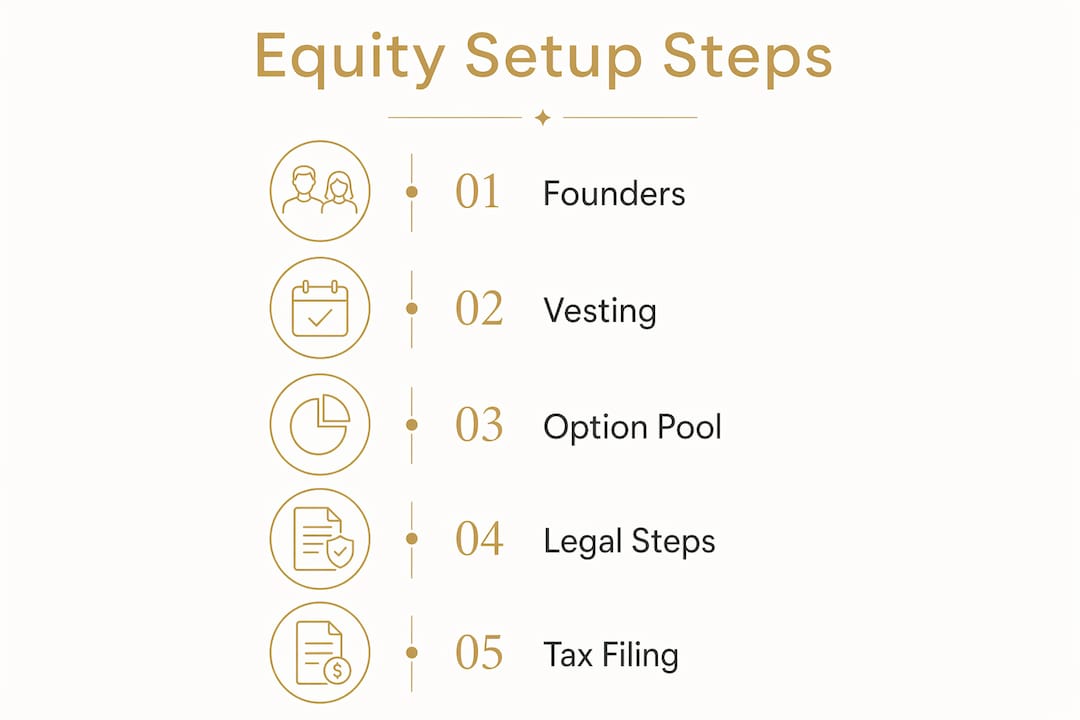
Every equity issuance must be a documented corporate act. Board approval, stock purchase agreements, and IP assignments must all be executed correctly and in the right order. Skipping steps or doing them out of sequence creates what lawyers call "ordering bugs," which are errors in the corporate record that surface during due diligence and can delay or kill a funding round.
The sequence matters:
- Incorporate the company in the chosen state, typically Delaware for venture-backed startups.
- Authorize the stock structure in the certificate of incorporation, including share classes and total authorized shares.
- Pass board resolutions approving the issuance of founder shares at the stated price per share.
- Execute founder stock purchase agreements with vesting schedules and repurchase rights attached.
- Assign IP to the company before or simultaneously with stock issuance. Founders who assign IP after receiving stock create a gap that investors will flag.
- File 83(b) elections within 30 days of stock purchase. Missing this 30-day deadline results in ordinary income taxation on each future vesting date, creating a tax liability that compounds over four years. There is no cure for a missed deadline.
- Create the option pool and adopt an equity compensation plan with board and shareholder approval.
- Maintain a current cap table that reflects every issuance, grant, and transfer in real time.
The timing and order of these steps is not a formality. Fixing errors during due diligence is expensive and complex. Investors have seen every variation of a messy cap table, and they price that risk into their terms.
Pro Tip: Use a cap table management tool from day one. Tracking equity in a spreadsheet works at formation but breaks down quickly once you add an option pool, advisors, and a seed round. A clean cap table is a fundraising asset.
Key Takeaways
A correctly structured startup equity setup requires vesting schedules, a properly sized option pool, dual-class governance, and legally documented issuances executed in the right order from incorporation.
| Point | Details |
|---|---|
| Vesting protects the company | A four-year schedule with a one-year cliff prevents early departures from destabilizing the cap table. |
| Size the option pool carefully | A pool between 10% and 20% of fully diluted shares balances talent needs with founder dilution. |
| Set up dual-class stock at incorporation | Adding voting control structures later requires shareholder approval and is rarely achievable post-investment. |
| File the 83(b) election within 30 days | Missing this deadline creates compounding tax liability on every future vesting date with no remedy available. |
| Document every issuance as a corporate act | Board resolutions, IP assignments, and stock agreements must be executed in the correct order to survive due diligence. |
Why I think most founders get equity wrong before they even start
Most founders spend more time on their pitch deck than on their equity structure. That is backwards. The pitch deck gets you a meeting. The equity structure determines whether you can close the deal, keep your co-founders, and retain control of the company you built.
The mistake I see most often is negotiating equity percentages without running a single dilution model. A founder who agrees to a 15% option pool at seed, then raises a Series A that requires a 10% top-up, can end up owning less than 30% of their company before the first product ships. That is not a tragedy if you modeled it in advance. It is a shock if you did not.
The 83(b) election is the other landmine. Founders who miss the 30-day window do not just pay more tax. They pay ordinary income tax on the value of shares as they vest, which means a tax bill tied to a stock price they cannot control and cannot sell. I have seen founders owe six figures in taxes on shares they cannot liquidate.
My honest advice: treat your equity structure the same way you treat your product architecture. Get it right at the start, document every decision, and model what it looks like three rounds from now. The founders who do this walk into investor meetings with confidence. The ones who do not spend those meetings explaining why their cap table is a mess.
— Noah
How Eliteformations helps founders build the right structure
Setting up a startup correctly is not just about filing paperwork. It requires the right entity type, the right stock structure, and documentation that holds up under investor scrutiny.

Eliteformations specializes in forming C-Corps, LLCs, S-Corps, and non-profit organizations with a level of personal attention that most formation services do not offer. Every client receives a callback within 24 hours, and every document is manually prepared and double-checked for accuracy. For founders building their equity structure from day one, Eliteformations handles all required filings with state and federal agencies, removes the guesswork from the formation process, and gives you a clean legal foundation before your first investor conversation.
FAQ
What is a startup equity structure setup?
A startup equity structure setup is the formal process of allocating ownership shares, defining stock classes, establishing vesting schedules, and documenting all equity issuances at incorporation. It determines who owns what percentage of the company and under what conditions.
What is the standard vesting schedule for startup founders?
The standard vesting schedule is four years with a one-year cliff. Twenty-five percent of shares vest at the 12-month mark, and the remaining 75% vest monthly or quarterly over the following three years.
How big should a startup option pool be?
Option pools are typically sized between 10% and 20% of fully diluted shares. The right size depends on your hiring plan and how many rounds of funding you expect before the pool needs to be topped up.
What happens if I miss the 83(b) election deadline?
Missing the 30-day filing deadline means you will owe ordinary income tax on the fair market value of shares each time they vest, not at the time of purchase. There is no way to fix a missed 83(b) deadline after the window closes.
When should I set up dual-class stock?
Dual-class stock must be established at incorporation. Adding it after investors are on the cap table requires their approval, which is rarely granted. Founders who want voting control must build it into the original certificate of incorporation.