
Formation documents are the legal papers that create a startup as a recognized business entity, defining its structure, ownership, and internal rules from day one. The role of formation documents in startups extends far beyond a one-time filing. These records govern how decisions get made, who owns what, and whether investors can trust what they see during due diligence. Without a complete, properly ordered set of startup incorporation papers, founders face tax penalties, ownership disputes, and fundraising delays that are expensive to fix after the fact.
What are the essential formation documents every startup must have?
Every US startup needs a specific set of core documents to be legally operational and investor-ready. Minimum essential formation docs include the Certificate of Incorporation or Articles of Organization, Bylaws or an Operating Agreement, an Incorporator's Statement, Board and Stockholder Consents, Founder Stock Purchase Agreements, 83(b) elections, and Confidential Information and Inventions Assignment Agreements (CIIAAs). Each document serves a distinct function, and missing even one creates gaps that surface at the worst possible moment.
Here is what each document does and why it belongs in your formation document checklist:
- Certificate of Incorporation or Articles of Organization. This is the founding document filed with the state. For Delaware C-corps, it establishes the legal entity and sets the authorized share count. Getting this right from the start matters because amending it later requires stockholder approval, which is difficult to obtain.
- Bylaws or Operating Agreement. Bylaws govern how a corporation runs internally: board meetings, voting thresholds, officer roles, and decision-making authority. An LLC uses an Operating Agreement for the same purpose. These are the rules your company lives by.
- Incorporator's Statement and Initial Consents. The Incorporator's Statement appoints the first board of directors. Board and Stockholder Consents then formally approve the company's initial actions, from adopting bylaws to issuing founder shares. Without these, no corporate action has a documented legal basis.
- Founder Stock Purchase Agreements with vesting. These agreements transfer shares to founders under a vesting schedule. Standard vesting is 4 years with a one-year cliff, meaning founders earn their equity over time rather than all at once. This protects the company if a co-founder leaves early.
- 83(b) election. Filed with the IRS within 30 days of stock issuance, this election locks in the tax basis at the time of grant rather than at vesting. Missing this window is not fixable.
- Confidential Information and Inventions Assignment Agreement (CIIAA). Every founder, employee, and contractor must sign one. This document assigns all IP created for the company to the company itself.
- Equity incentive plan and 409A valuation. Once you plan to grant options to employees, you need a board-approved equity plan and a third-party 409A valuation to set a defensible fair market value for common stock.
Pro Tip: File your 83(b) election by certified mail with return receipt requested. Keep a copy of the postmarked envelope. The IRS does not send confirmation, and proof of timely filing is your only protection.
How do formation documents enforce governance and ownership structures?

Formation documents are the legal proof that your company exists, that its leaders have authority to act, and that its ownership is clean. Bylaws, consents, and a stock ledger together prove existence, authority, and ownership. Investors require all three during fundraising diligence, and gaps in any one of them create red flags that slow or kill deals.
Governance pitfalls are more common than founders expect. Here are the most damaging ones and what they cost:
- No formal board consents for key decisions. Every material corporate action, from opening a bank account to signing a major contract, requires a board consent. Without one, the company cannot prove it had authority to act. Banks and investors both ask for these.
- Cap table misalignment. The cap table must match the stock ledger, which must match the Stock Purchase Agreements. Any discrepancy signals informal management and raises questions about who actually owns what percentage of the company.
- Issuing shares without a board consent. Stock issuances require formal board approval. Founders who skip this step create shares that may not be legally valid, which requires expensive legal reconstruction later.
- Unclear decision-making authority. Bylaws define who can sign contracts, hire executives, and approve budgets. Without clear rules, founders make decisions informally, which creates disputes when the company grows or a co-founder exits.
- Missing stockholder consents for major actions. Certain decisions, like amending the Certificate of Incorporation or approving a merger, require stockholder approval. Skipping this step creates a defective corporate record.
Pro Tip: Build a simple folder structure from day one: one folder per corporate action, each containing the consent, the signed agreement, and any related filing. This turns weeks of diligence prep into hours.
Creating a run-book of all legal documents during the first 30 days reduces investor diligence from weeks to hours. That is not an exaggeration. Investors have seen both organized and disorganized cap tables, and they move faster and with more confidence when the paper trail is clean.
What are common legal pitfalls in startup formation paperwork?
The most expensive formation mistakes are not the ones founders know to avoid. They are the ones that seem minor at the time and become catastrophic during a Series A or an acquisition.
- Missing or unsigned CIIAAs. Investors treat missing IP assignments as a hidden lien on the company's assets. If a founder or early contractor built core technology without signing a CIIAA, the company may not legally own its own product. This single gap has killed acquisitions and stalled fundraising rounds.
- Missing the 83(b) deadline. The 30-day window from the stock transfer date is an absolute IRS requirement. Missing it means founders pay ordinary income tax on the full value of their shares as they vest, which can mean tens of thousands of dollars in avoidable tax liability. This deadline cannot be extended or cured.
- Ordering bugs. Granting options before a 409A valuation or issuing stock before signing a CIIAA creates what lawyers call "ordering bugs." These are incorrect sequences of legal actions that require expensive reconstruction during due diligence. The fix is always harder and costlier than doing it right the first time.
- Under-authorizing shares. Delaware C-corps should authorize 10 million shares at $0.00001 par value as a standard starting point. Under-authorizing forces founders to amend the Certificate of Incorporation mid-financing, which requires stockholder approval and delays closing.
- Gaps in board or stockholder consents. Every corporate action needs a paper trail. A missing consent for a key hire, a lease, or a licensing agreement means that action may be legally questionable. Investors notice these gaps and ask hard questions.
- Delaying formation to avoid complexity. Some founders operate informally for months before incorporating. Every day of informal operation creates potential ownership disputes, tax complications, and IP ownership questions that cost money to resolve.
The pattern across all these pitfalls is the same: founders treat startup formation paperwork as a formality rather than as legal infrastructure. Formation documents are the structural foundation of startup operations. Errors cascade, making future banking, hiring, and fundraising complex and expensive.
How should founders approach creating and managing formation documents?
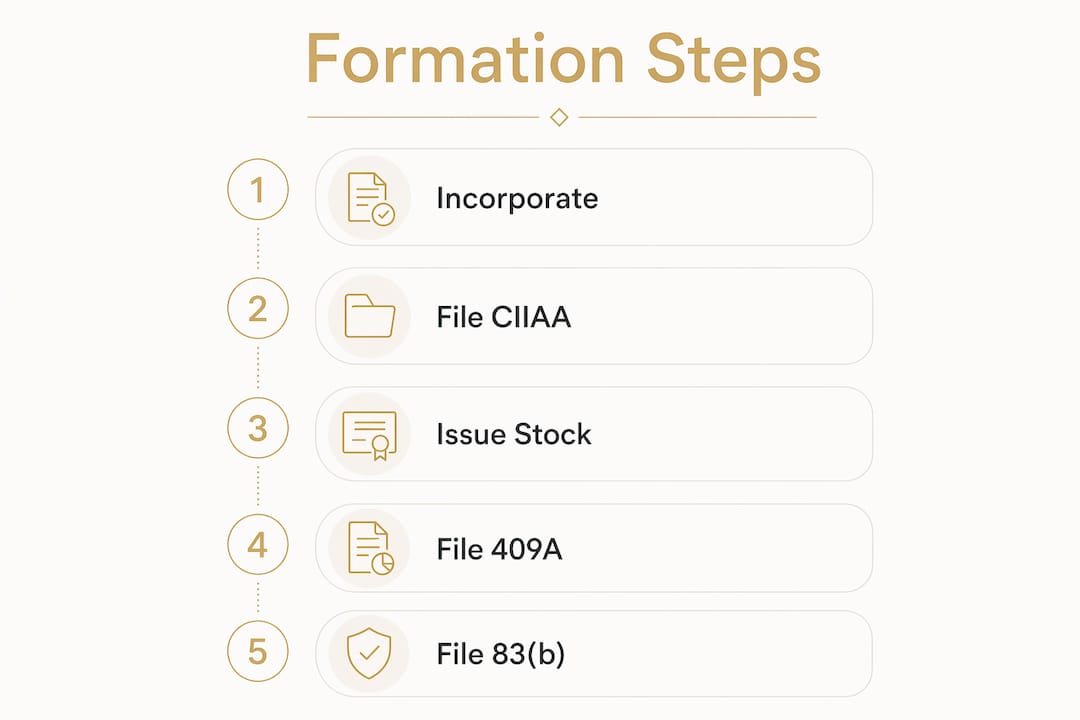
The right approach treats formation documents as legal infrastructure, not a one-time task. Here is the recommended order of operations for the first 30 days after incorporation:
- File the Certificate of Incorporation. Do this before any other action. The company does not legally exist until this is filed and accepted by the state.
- Execute the Incorporator's Statement. Appoint the initial board of directors immediately after filing.
- Adopt Bylaws and initial Board Consents. Approve the Bylaws, authorize the company's bank account, and document every initial corporate decision in writing.
- Sign CIIAAs with all founders. Do this before issuing any stock. IP assignment must precede equity issuance.
- Issue founder shares via Stock Purchase Agreements. Execute these agreements with the board consent authorizing the issuance.
- File 83(b) elections. File within 30 days of the stock transfer date. Set a calendar reminder the day you sign the Stock Purchase Agreements.
- Get a 409A valuation before granting any options. Once you plan to hire employees with equity, commission a third-party 409A valuation first.
The following table shows the key documents, their purpose, and the critical timing for each:
| Document | Purpose | Critical timing |
|---|---|---|
| Certificate of Incorporation | Creates the legal entity | Before any other action |
| Bylaws and Board Consents | Establishes governance rules | Within first week |
| CIIAA | Assigns IP to the company | Before issuing any stock |
| Founder Stock Purchase Agreement | Documents equity ownership | After CIIAA is signed |
| 83(b) election | Locks in tax basis at grant | Within 30 days of stock issuance |
| 409A valuation | Sets fair market value for options | Before first option grant |
A clean, standard setup executed quickly is better than an over-engineered one that takes months. Lawyers consistently advise founders to prioritize standard, compliant documentation over premature customization. You can refine governance structures as the company grows. You cannot undo a missed 83(b) deadline.
Key Takeaways
Proper formation documents are the legal backbone of every startup, and errors in sequencing or completeness create costs that compound over time.
| Point | Details |
|---|---|
| File in the right order | CIIAA must be signed before stock is issued; 409A must precede any option grants. |
| Never miss the 83(b) deadline | The 30-day window from stock issuance is absolute and cannot be extended or cured. |
| IP assignment is non-negotiable | Missing signed CIIAAs from founders or contractors can block fundraising and M&A deals. |
| Authorize enough shares upfront | Delaware C-corps should start with 10 million shares to avoid costly mid-financing amendments. |
| Treat documents as infrastructure | A complete, consistent paper trail turns weeks of investor diligence into hours. |
Why formation documents deserve more respect than most founders give them
Most founders spend weeks debating their product roadmap and less than a day on their legal setup. I understand why. Formation paperwork feels like a bureaucratic hurdle, not a competitive advantage. That view is wrong, and I have seen it cost founders real money.
The founders who get this right early share one habit: they treat their legal documents the same way they treat their codebase. They version-control it, they review it regularly, and they never let it fall out of sync with reality. The ones who skip this step spend their Series A prep fixing problems that should have taken 30 minutes to prevent.
Incorporation is more than a filing. It is building a documented legal record that proves existence, authority, and ownership. Every investor you will ever meet has seen a cap table that does not match the stock ledger, or a company that cannot prove it owns its own IP. They walk away from those deals. Do not give them a reason to walk away from yours.
My honest advice: get your formation documents done correctly in the first 30 days, keep them organized, and review them every time something significant changes. That discipline pays for itself the first time an investor asks for your data room.
— Noah
Eliteformations helps founders get formation right from day one
Getting your formation documents right is not just about compliance. It is about building a company that investors trust and that operates without legal landmines.

Eliteformations specializes in forming LLCs, S-Corps, C-Corps, and non-profit organizations with a level of personal attention that most founders never experience. Every document is manually prepared and double-checked. Every client receives a callback within 24 hours. If you want a clean legal foundation built correctly from the start, without the guesswork of doing it alone, Eliteformations handles every required filing with state and federal agencies so you can focus on building your company.
FAQ
What is the role of formation documents in startups?
Formation documents legally establish the startup as a business entity and define its governance, ownership, and compliance structure. They are the legal foundation investors, banks, and regulators require before engaging with the company.
What happens if a founder misses the 83(b) election deadline?
Missing the 30-day filing window is permanent and cannot be cured. Founders who miss it pay ordinary income tax on the full value of their shares as they vest, which can result in tens of thousands of dollars in avoidable tax liability.
Why do investors care about formation documents during due diligence?
Investors use formation documents to verify that the company legally exists, that its leaders have authority to act, and that its ownership is clean. Missing consents, unsigned IP assignments, or cap table discrepancies are treated as red flags that can delay or kill a deal.
What is a CIIAA and why does every founder need one?
A Confidential Information and Inventions Assignment Agreement (CIIAA) assigns all IP created for the company to the company itself. Without signed CIIAAs from every founder, employee, and contractor, the company may not legally own its own product or technology.
How many shares should a Delaware C-corp authorize at incorporation?
The standard recommendation is 10 million shares at $0.00001 par value. Under-authorizing shares forces a mid-financing amendment to the Certificate of Incorporation, which requires stockholder approval and delays fundraising.